



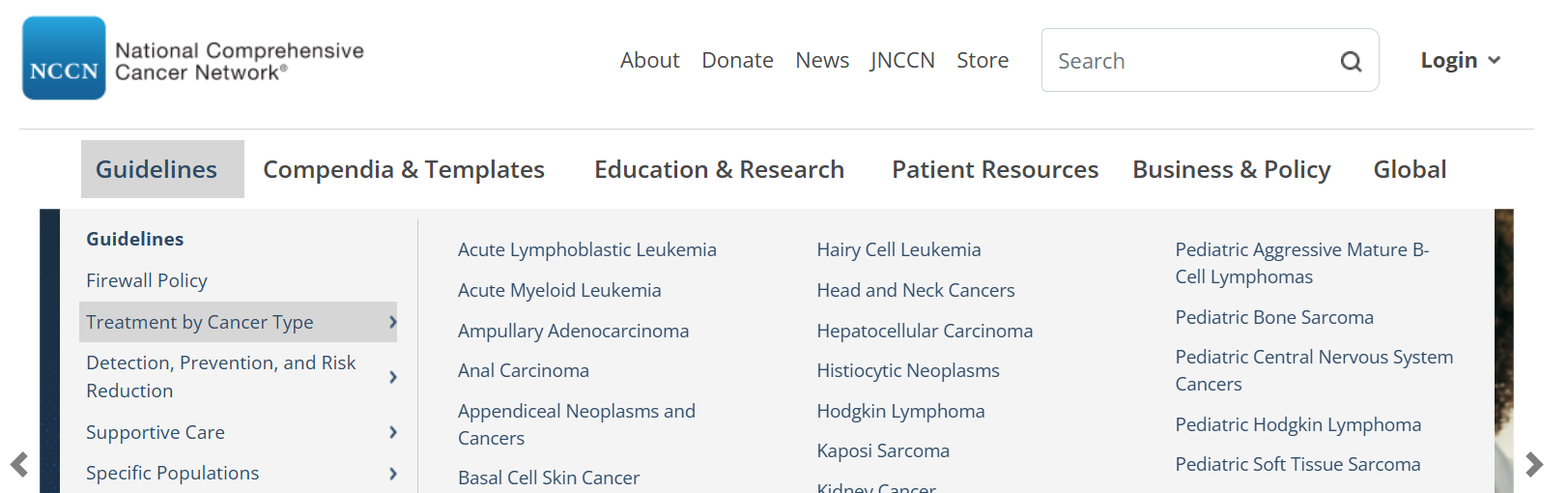
The National Comprehensive Cancer Network® (NCCN®) is a not-for-profit alliance of 34 leading cancer centers devoted to patient care, research, and education.
Their website offers:
- an extensive collection of guidelines on various types of cancer for both clinicians and patients, in several languages (you will find the list in the text below or on the left edge of this page).
- drugs and biologics compendium,
- biomarker compendium,
- radiation therapy compendium,
- event calendar,
- patient webinars.
The guidelines are written in English and gradually localized, but you will need to verify the available language for each patient guideline and healthcare practitioner guideline separately.
Here is the list of all NCCN guidelines available in October 2026 (the documents are constantly revised and updated).
Treatment guidelines:
- Acute Lymphoblastic Leukemia
- Acute Myeloid Leukemia
- Anal Carcinoma
- Basal Cell Skin Cancer
- B-Cell Lymphomas
- Biliary Tract Cancers
- Bladder Cancer
- Bone Cancer
- Breast Cancer
- Central Nervous System Cancers
- Cervical Cancer
- Chronic Lymphocytic Leukemia/Small Lymphocytic Lymphoma
- Chronic Myeloid Leukemia
- Colon Cancer
- Dermatofibrosarcoma Protuberans
- Esophageal and Esophagogastric Junction Cancers
- Gastric Cancer
- Gastrointestinal Stromal Tumors
- Head and Neck Cancers
- Hepatocellular Carcinoma
- Hodgkin Lymphoma
- Kidney Cancer
- Melanoma: Cutaneous
- Multiple Myeloma
- Myelodysplastic Syndromes
- Myeloproliferative Neoplasms
- Neuroendocrine and Adrenal Tumors
- Non-Small Cell Lung Cancer
- Occult Primary
- Ovarian Cancer/Fallopian Tube Cancer/Primary Peritoneal Cancer
- Pancreatic Adenocarcinoma
- Prostate Cancer
- Rectal Cancer
- Small Bowel Adenocarcinoma
- Small Cell Lung Cancer
- Soft Tissue Sarcoma
- Squamous Cell Skin Cancer
- T-Cell Lymphomas
- Testicular Cancer
- Uterine Neoplasms
- Vulvar Cancer
Prevention and diagnosis guidelines:
- Breast Cancer Risk Reduction
- Breast Cancer Screening and Diagnosis
- Genetic/Familial High-Risk Assessment: Breast, Ovarian, Pancreatic, and Prostate
- Genetic/Familial High-Risk Assessment: Colorectal, Endometrial, Esophageal, and Gastric
- Lung Cancer Screening
Guidelines for Supportive Care:
- Antiemesis
- Cancer-Related Fatigue
- Hematopoietic Growth Factors –
- Management of Immune Checkpoint Inhibitor-Related Toxicities
- Palliative Care
- Prevention and Treatment of Cancer-Related Infections
The guideline translations are available here, including Arabic, Bengali, Chinese, French, German, Hindi, Italian, Japanese, Kannada, Korean, Polish, Portuguese, Romanian, Russian, Spanish, Spanish for Latin America, Ukrainian, Urdu, and Vietnamese (not all guidelines are available in all languages).
There is a separate section for patient guidelines (written in plain language) and patient guideline translations in Arabic, Chinese, French, German, Hindi, Hungarian, Japanese, Polish, Portuguese, Russian, Spanish, and Vietnamese (not all guidelines are available in all languages).
Also, some treatment guidelines have been updated with evidence levels. These versions are currently available for selected guidelines and only in English here.
NCCN also launched the Guidelines Navigator, a tool to browse all the guidelines. The Navigator is available for logged-in users here.
International adapted versions are available for specific guidelines. You can check the list of guidelines adapted for each region and the available languages here.
NCCN also hosts a continuing education portal for healthcare practitioners, featuring paid and free offline and online events.
Why clinical guidelines are useful for translators and writers
Clinical guidelines are a valuable source of information and terminology for medical translators and writers. Here’s why:
- they’re built on a rigorous literature search and analysis;
- everything is explained and backed by evidence;
- the language is fairly accessible — as long as you have some basic knowledge of the topic;
- plenty of tables and diagrams;
- they cite additional literature (sources for further reading).
Tip: if you’re just getting into a topic, read the guidelines in your native language.


 Copy link
 E-mail
 LinkedIn
 Facebook
 Telegram
 WhatsApp
